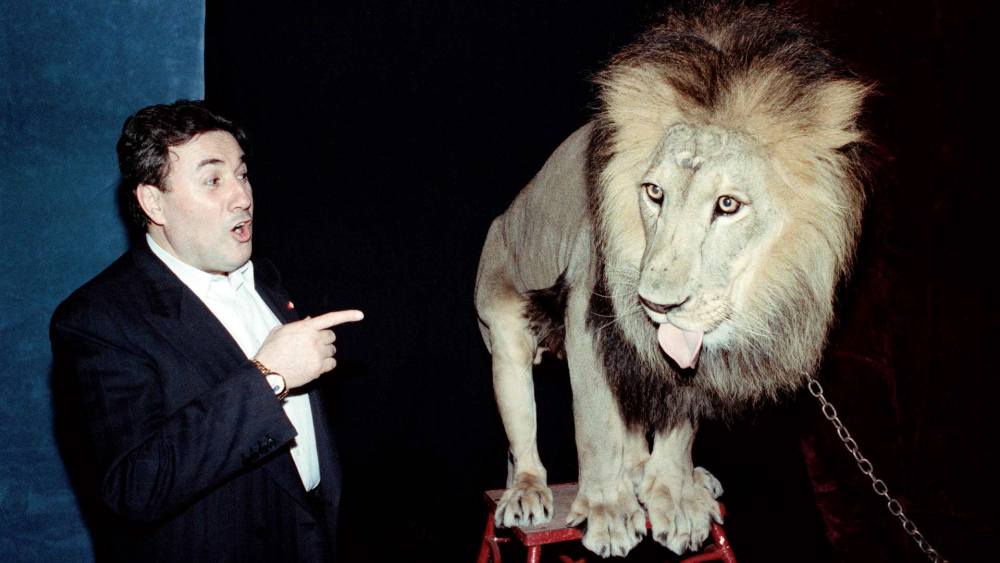
By 1994 Crédit Lyonnais was starting to falter, their most notorious client was Giancarlo Parretti. Parretti was a financier and in 1989 he had acquired a controlling interest in indie studio The Cannon Group renaming it as Pathé Communications, as he intended to take over the French studio Pathé. However, the French government blocked his bid due to concerns about his background In 1990 he was able to acquire Metro-Goldwyn-Mayer with financial aid from Time Warner and Turner Entertainment Co, with a line of credit provided by Crédit Lyonnais Bank, N.V. (the Dutch branch of the bank that handled loans given out to independent filmmakers.) Upon the approval of the merger he laid off a majority of the financial staff and appointed his daughter Valencia to a financial position.
After Parretti was put in charge chaos began to erupt at MGM, a bounced check to Dustin Hoffman, a delayed opening of “Thelma & Louise” and an unpaid loan owed to Sean Connery. More problems arose when it was discovered that Parretti didn’t pay laboratory bills, creditors, and would use studio earned money for his own needs, like showering girlfriends with gifts. By March 1991 MGM was looking at a lawsuit against its clients as they had been unpaid.
The studio almost filed for chapter 7 bankruptcy, and Crédit Lyonnais refused to help supply needed funds unless Parretti was ousted. Former president Alan Ladd, Jr. was brought in to replace Parretti, and named James Kanter as Chief Operating Officer. This change in management saved from MGM from bankruptcy. Ladd and Parretti were in a bitter power struggle, upon discovering he was trying to regain control of MGM, Crédit Lyonnais announced that they would seize full control of the studio on June 17, 1991.
Parretti himself would later face securities fraud charges in the United States as well as Europe. On the verge of bankruptcy Crédit Lyonnais announced it would foreclose on the studio in 1992, and MGM-Pathé became merely a subsidiary, then was reverted back to its original name Metro-Goldwyn-Mayer. Parretti had attempted one last time to gain control of the company, by insisting they sell off key assets to generate revenue to pay off outstanding loans and debts owed to the bank. The committee declined due to concerns over the price adequacy of the portions of the company Parretti wished sold.
Management at MGM switched again this time the bank brought in former Paramount Pictures executive Frank Mancuso, Sr. to replace Ladd, Mancuso brought in Michael Marcus to head MGM and former Warner Bros. executive John Calley as head of the new United Artists. 1994 was another troubled year for the bank as it had decided to close down its Epic Productions company. As a result of that the bank ended up owning titles and various rights to the studios it had lent money out to. Three years prior the bank had also acquired a junk bond interest in the life insurance company Executive Life via its Altus Finance unit.
The deal with Parretti put a severe financial strain on the bank, and by 1995 it was forced to undergo reorganization. The debt was so crippling that the French government had to call for a bailout. Not to mention there had been a few lawsuits against the bank, including one involving breach of contract, racketeering, fraud and equitable subordination filed by US client Hemdale. The bank would later restructure and sell off its assets that were superfluous, and formed a firm known as Consortium de Realistaion (Consortium of Realization) which would manage the copyrights and international rights to any titles that were acquired by Epic in 1993/1994.
Consortium of Realization was a library of 1,000 motion pictures, which included Atlantic Releasing Corporation/Island Films, Sherwood Productions/Gladden Entertainment, the home video rights to the Embassy Pictures titles and Castle Rock films as well as the copyrights to Nelson films. In 1996 it was announced that the bank would sell off MGM and this library, as obligated by US laws. Movie mogul Kirk Kekorian acquired the movie company for a third time now through an investment, he had taken control of it prior to Parretti back in 1986 when it was sold by Ted Turner.
Crédit Lyonnais then put the CDR/Epic library up for sale, MGM was one of the bidding companies. Behind Live Entertainment and The Walt Disney Company, but all three would eventually be outbid by UK based PolyGram Filmed Entertainment who acquired the Epic titles for $225 million.
Crédit Lyonnais’ days as a movie financier were over, and the bank never recovered its reputation after this widely known scandal. But, despite it independent filmmakers are still around and by 1995 some of them learned that they could get financing elsewhere. Several companies had formed at the time including Rysher Entertainment and Savoy Pictures. In the next part we will discuss the aftermath of this scandal and how US laws were changed to avoid this from happening again.
 Bestower of Film Knowledge